
The old note will continue to be accepted for other utility bill payments as well as at railway ticketing counters and counters of government or public sector undertaking buses for purchase of bus tickets till December 15

The government has slashed the windfall profit tax levied on domestically-produced crude oil as well as on export of diesel and ATF following a drop in global oil prices, according to an official order. The levy on crude oil produced by companies such as Oil and Natural Gas Corporation (ONGC) has been cut steeply to Rs 1,700 per tonne from Rs 4,900, the order dated December 15 said. Crude oil pumped out of the ground is refined and converted into fuel like petrol, diesel and aviation turbine fuel (ATF).

With the deal closing, SoftBank becomes an investor in two of India's largest on-demand cab service -- Uber and Ola.

Several members had moved adjournment motions to raise the issue, but Speaker Meira Kumar said she has not accepted the demand.

Oil marketing companies IOC, BPCL and HPCL have invited expressions of interest from start-ups that wish to be enrolled as fuel entrepreneurs for doorstep delivery of high-speed diesel through mobile petrol pumps.

It is time he stood up and assured the middle class that they can count on him as one of their own, says Dr Sudhir Bisht.
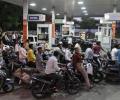
In Maharashtra, the oil industry had tenancy protection till 1999.

Soaring fuel prices give birth to a jugaad system in Bihar's border towns abutting Nepal with residents smuggling in India-supplied cheaper petrol and diesel from the mountain kingdom.

'The prime minister took a meeting recently and he asked for suggestions and ideas for a plan till 2047.'
Indian imports of Russian oil plunged by a record in August month-on-month (M-o-M) as discounts on the fuel shrank in tandem with rising Brent oil prices. Higher crude prices will drive inflation or hurt earnings at oil companies and India's fiscal position if such spikes are not passed on to consumers. Indian purchases of Russian crude declined by around 24 per cent in August from July to the lowest level since January, with refiners expecting volumes to drop further amid rising rates of Russian benchmark Urals grade, substantial stocks at refiners, and planned maintenance at Indian refineries, according to ship tracking data and industry officials.

Oil marketing cos rightly passed on the burden to buyers.

The civic authorities have moved to clear roads which have become slushy and strewn with garbage, and are also gearing up to tackle rush of patients in municipal hospitals.

The Union petroleum minister has assured the petroleum dealers that he would discuss with the Maharashtra government to bring sales tax rates at par with neighbouring states.

Petrol and diesel sales in India jumped in September as economic activity picked up with the nearing festival season and the ending of the monsoon raised the demand, preliminary industry data showed. Petrol sales soared 13.2 per cent to 2.65 million tonnes in September when compared to 2.34 million tonnes of consumption in the same month last year. Sales were 20.7 per cent higher than Covid-marred September 2020 and 23.3 per cent more than pre-pandemic September 2019.
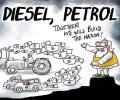
The government on Friday slapped an export tax on petrol, diesel and jet fuel (ATF) while also joining nations like the UK in imposing a windfall tax on crude oil produced locally. A Rs 6 per litre tax on export of petrol and ATF and Rs 13 per litre tax on export of diesel is effective from July 1, finance ministry notifications showed. Additionally, a Rs 23,250 per tonne tax was levied on crude oil produced domestically.

Tata Power declared encouraging results for the April-June quarter (Q1) of the 2023-23 financial year (FY24). The firm's revenue rose 5 per cent year-on-year (Y-o-Y) to Rs 15,210 crore. It was driven by higher sales to distribution companies (discoms) and capacity addition in renewables. Company's adjusted profit after tax (PAT) rose 3 per cent to Rs 906 crore with reported PAT at Rs 1,100 crore on a one-time gain of Rs 235 crore.

'The government never asked any transport association before making this law on hit and run cases.' 'MPs only clapped to Amit Shah's new law and never questioned him about this law.' 'Are these MPs not bothered about the lives of drivers?'

'If we don't control the additional pollutants that come from various human activities then, the pollution level will not come down.'

After two days of lull, petrol and diesel prices on Thursday were again hiked by 35 paise per litre, sending retail pump prices to their highest ever level across the country.
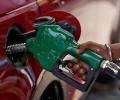
Petrol doped with 20 per cent ethanol was rolled out on Monday at select petrol pumps in 11 states and union territories as part of a programme to increase use of biofuels to cut emissions as well as dependence on foreign exchange-draining imports. At present, 10 per cent ethanol is blended in petrol (10 per cent ethanol, 90 per cent petrol) and the government is looking to double this quantity by 2025. Prime Minister Narendra Modi launched the higher 20 per cent ethanol blended petrol two months ahead of the planned rollout in April, at the India Energy Week (IEW) 2023 in Bengaluru.

Uber India has readied itself for another $500 million (Rs 3,300 crore) investment in the next three months.

Meghalaya Chief Minister Conrad Sangma on Thursday said Union Home Minister Amit Shah has given firm assurances at a meeting held in Delhi of acting on his request for a Central Bureau of Investigation (CBI) probe into the 'firing by Assam Police' along the states' border.

Only a few thousand chargers dot the Indian landscape, some in working condition, others not, with some held hostage to the power supply vagaries of local utilities, reports S Dinakar.

Amid a shift in mobility trends and people increasingly opting for less polluting energy sources, sales of compressed natural gas (CNG) vehicles increased more than 82 per cent in the past five years. A total of 729,902 CNG vehicles were sold in 2022-23 against 400,825 in 2017-18, according to VAHAN Dashboard. Though the increase in sales of CNG-powered vehicles has been significant, their share in overall vehicle sales remains minuscule as is the case with EVs.

India's trade account could come under pressure and there could be an inflation push if crude oil prices remain above the $90 per barrel (Brent) for a prolonged period since India imports over 85 per cent of its oil and roughly 50 per cent of its gas. A rebound in economic activity is bound to lead to higher fuel demand. While India is the third-largest importer of crude, it is a net exporter of refined products, which helps to compensate to some degree.

Govt's move will facilitate entry of global giants such as Total SA of France, Saudi Arabia's Aramco, BP Plc of the UK, and Trafigura's downstream arm Puma Energy.
Petrol and diesel sales in the country fell in July over the previous month as the onset of monsoon chipped away demand in some sectors and restricted mobility, preliminary industry data showed. Diesel, the most widely used fuel in the country, saw consumption drop 13.1 per cent to 6.44 million tonnes from 7.39 million tonnes of demand in June. The arrival and intensity of monsoon weigh heavily on diesel demand in the country and consumption traditionally is lower in July-September than in April-June.

According to the Ministry of Energy, the system of frequency of the national grid went down at 7:34 am local time, resulting in the breakdown.

The WR is taking various measures including setting up disaster management rooms, help desks, and keeping relief trains ready.

Instead of lowering the altitude, the pilot responded by saying that he was satisfied. When only 10 nautical miles were left till the airport, the plane was at an altitude of 7,000 feet instead of 3,000 feet, it said. The ATC issued a second warning to the pilot to lower the plane's altitude. However, the pilot responded again by stating that he was satisfied and would handle the situation, saying he was ready for landing, the report said.
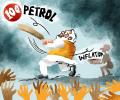
After premium petrol, the price of normal petrol has also crossed Rs 100 per litre in Rajasthan's Sriganganagar district.
State-run Bharat Petroleum Corporation Ltd on Wednesday said it will invest up to Rs 350-400 crore (Rs 3.5-4 billion) this fiscal to add about 1,500

According to sources, Russian energy giant Rosneft or its affiliates, Saudi Aramco and Reliance Industries are in race for BPCL's three refineries - Mumbai, Kochi in Kerala and Bina in Madhya Pradesh - 16,309 petrol pumps, 6,113 LPG distributor agencies and more than a fifth of 256 aviation fuel stations in the country.
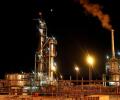
India's import of discounted crude oil from the Russian Federation hit an all-time high in May, with state-run refiner IOC becoming the biggest importer of Russian oil, relegating Reliance Industries to the second place, trade and shipping data show. Indian imports of Russian oil, accounting for over 46 per cent of its total crude oil imports in May, have grown after strong backing by New Delhi, with state-run refiners powering imports of discounted crude. Discounts on Russian oil average around $10 a barrel, said an official from a state-run refiner. IOC's May purchases rose by 64 per cent on the month, and accounted for half of its total crude imports last month, ship tracking data show.
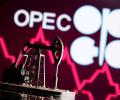
Changes in global oil and gas rates matter more to India's economy than other major economies because the country imports around 87 per cent of its oil, half of its gas in the form of LNG, and over 60 per cent of its LPG.

India may see a structural shift in supplies of crude oil with Russia emerging as a key source of fuels, a development that reduces New Delhi's dependence on West Asian oil, gives Indian refiners better bargaining power with price-setter Saudi Arabia, and improves overall energy security. The unexpected surge in supplies of Russian crude in the last few months, unthinkable until the war in Ukraine, may also deliver other unforeseen gains such as boosting exports of refined fuels to Europe, which historically has counted on Russian shipments. India has jumped on to the bandwagon of opportunistic buying of Russian crude but if calibrated carefully, Urals crude can be a long-term asset for India refiners.

The Vedanta group on Wednesday confirmed putting in a preliminary expression of interest (EoI) for buying the government's stake in Bharat Petroleum Corp Ltd (BPCL).

Glimpses of the protests in Colombo against the worsening economic crisis

Indian equity markets have a limited upside potential in the near-term as they negotiate the ensuing cyclical slowdown, wrote analysts at Nomura in a recent coauthored report led by Saion Mukherjee, their managing director and head of equity research for India. He, however, believes that the foundations are in place for sustainable growth over the medium-to-long term, and hence suggests a 'buy on dips' strategy to equity investors. As an investment strategy, Nomura prefers domestic-oriented sectors and companies over exporters, and prefers stocks that provide valuation comfort. Industrials and banks are their overweight sectors, while IT services and consumer discretionary are their underweight sectors.
